A year ago I couldn’t have told you what an Industrial Business Zone was. I definitely couldn’t have told you that there’s a motorcycle repair shop on Dobbin Street where the owner, Valerie, repairs the coolest Harley-Davidsons you’ve ever seen and gets noise complaints from people who live right beside her shop.
Or that there’s a 100-year-old industrial laundry on Franklin Street whose owner fields developer calls weekly and still shows up at 5 AM to run the boilers. Or that there’s a Charli XCX Brat wall three blocks from a steel fabricator who runs forklifts to a climbing gym because the trucks can’t make the turn anymore.
I started my Community Development Graduate Fellowship at Evergreen Exchange last September knowing almost nothing about manufacturing in New York. I’m finishing it having built a block-level early warning framework that maps displacement risk across 445 industrial lots in the Greenpoint-Williamsburg IBZ, and genuinely not wanting to stop working on it.
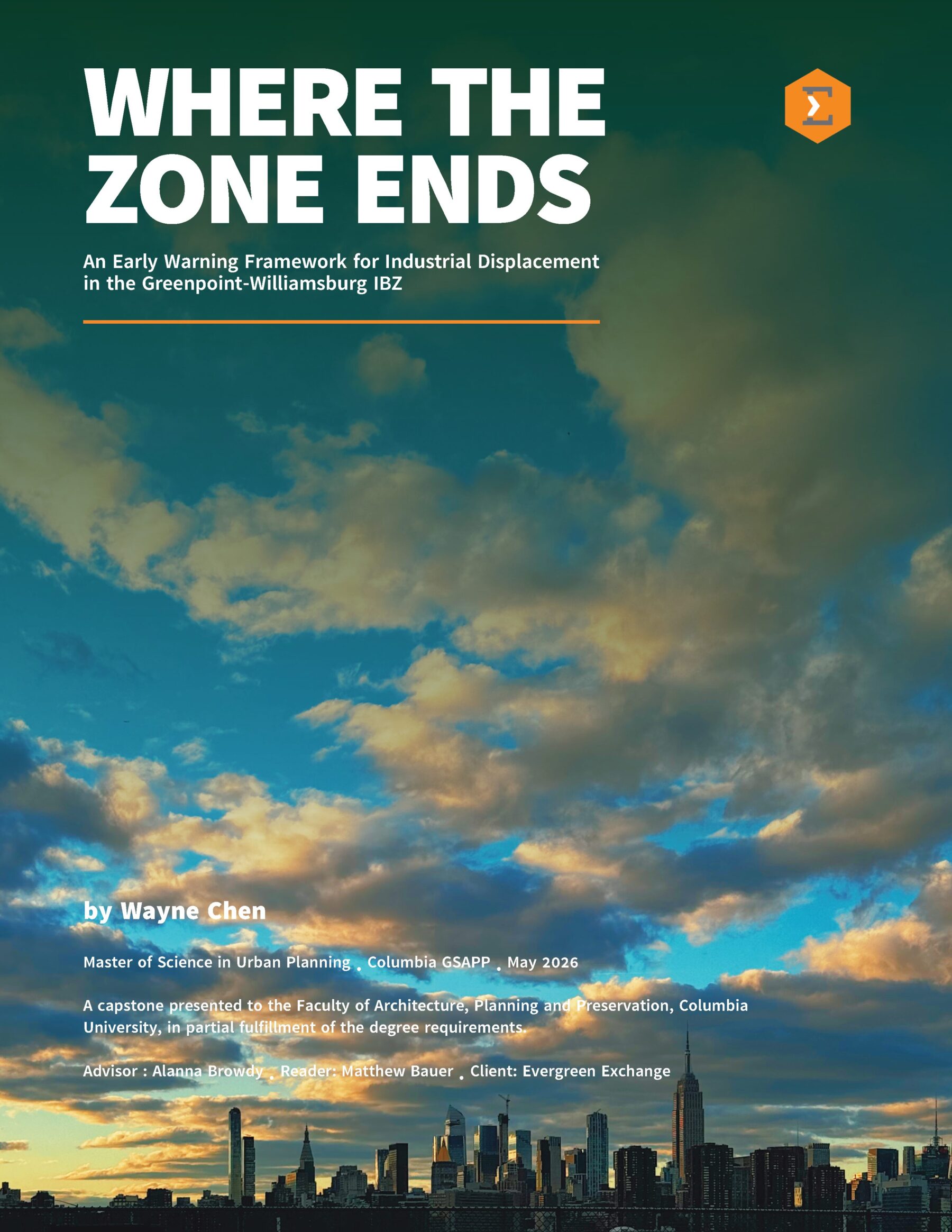 The capstone is called “Where the Zone Ends,” completed for my MS in Urban Planning at Columbia University Graduate School of Architecture, Planning & Preservation. Six public datasets, 16 binary indicators, a hotspot analysis, three displacement corridors, and recommendations addressed to named agencies on named blocks. The longer version is 80 pages and I’m unreasonably proud of it.
The work isn’t done. This summer I’m producing a District Needs Assessment for Evergreen that takes the same framework and repackages it for agency partners, Community Board 1, and the business operators who made this research possible.
What I didn’t expect was how much the qualitative work would matter. The numbers tell you which blocks are under pressure. They don’t tell you that a fabricator’s insurance got dropped because his parked truck was hit twice, or that a trucking company charges $200 extra per trailer to deliver on Berry Street, or that a smoked fish company that’s been on Gem Street for generations wrote that residential and manufacturing do not mix well. The framework detects displacement. The people I talked to this year explained it.
Shoutout to Karen Nieves and Stephen Fabian at Evergreen for trusting a planning student with their neighborhood. To my advisor Alanna Browdy for the guidance. To Pura Vida at 25 Kent for letting me use the restroom approximately 40 times during field work and never once asking me to buy anything. And to the operators across the GW IBZ who gave me their time, their data, and their candor. This is for them.
You can connect with Wayne on LinkedIn and read his capstone project here.